Hello and welcome to another Intensive Care at Home live stream. Today I want to talk about living with a ventilator and tracheostomy at home — real world adult and pediatric case studies. We will be going for about 45 minutes. If you have any questions in the meantime, please type them into the chatpad. We will probably have time for questions and answers at the end. If you have any questions on today’s topic, please type them in the chatpad. If we have enough time, you can talk to me directly. If you like my videos, like, comment, and subscribe to my YouTube channel so you do not miss out on any updates.
My name is Patrik Hutzel and I will be the host of this presentation. I am from intensivecareathome.com. I have worked in critical care nursing for over 25 years in three different countries, where I have worked as a nurse unit manager for over five years. I started Intensive Care at Home in 2012 in Australia, that is how long we have been operating and we are currently the only third-party accredited Intensive Care at Home nursing service specifically for Intensive Care at Home nursing. We are ISO 9001:2015 accredited as well as NDIS (National Disability Insurance Scheme) registered.
With Intensive Care at Home, we provide tailor-made solutions for long-term ventilated adults and children at home. We provide tailor-made solutions at home for long-term ventilated adults and children on BiPAP (Bilevel Positive Airway Pressure) and CPAP (Continuous Positive Airway Pressure). We provide tailor-made solutions for long-term tracheostomy clients without ventilation, adults and children at home. We provide home ventilation weaning and tracheostomy weaning when medically appropriate. We provide cough assist management at home, home TPN (Total Parenteral Nutrition), home IV fluids, home IV antibiotics, home IV potassium, magnesium and other electrolyte infusions, which goes hand in hand with central line, PICC (Peripherally Inserted Central Catheter) line, Hickman’s line, and port management at home. We provide IDC (Indwelling Catheter) and SPC (Suprapubic Catheter) management, PEG (Percutaneous Endoscopic Gastrostomy) and PEJ (Percutaneous Endoscopic Jejunostomy) tube, nasogastric tube and nasojejunostomy tube management at home, as well as palliative care management at home. We also provide Level 2 and Level 3 NDIS support coordination as well as TAC (Transport Accident Commission) case management.
Thank you for watching, and thank you to anyone watching this on replay. I know we have quite a large number of views on replay.
Today I want to answer a question I get asked more than almost any other, from families, from case managers, from NDIS support coordinators, from hospital discharge planners, sometimes from NDIS planners and complex planners, sometimes from doctors, sometimes from nurses. It is a question we get quite frequently: what does it actually look like, day to day, when a ventilator-dependent or tracheostomy-dependent adult or child lives at home instead of being stuck in ICU (Intensive Care Unit), or in a long-term acute care ward, or in a facility that is not equipped for them?
Instead of talking about this in abstract terms, I am going to walk you through four real, fully de-identified case studies from our own client base at intensivecareathome.com — two adults, two children. Every identifying detail — names, dates of birth, addresses, and contact details — has been removed or changed out of respect for client privacy. What remains is the clinical reality and the home care reality, because that is what matters for today’s conversation.
I started Intensive Care at Home in 2012. We are operating all around Australia in all states and territories, in all major capital cities, as well as in all regional and remote areas. I have worked in critical care nursing for over 25 years. I was part of starting Intensive Care at Home in Germany with a pioneering service in the early 2000s, a service called Bramring and Jaschke. Big shout out to my former colleagues Jürgen and Kristof, who were pioneers in Germany. I carried that torch forward when I came to Australia, because there was nothing in comparison here and a lot of long-term patients were stuck in ICU. We have given them a new life.
If you are in the US (United States), in Canada, in the UK (United Kingdom), in India, or any other country, stick with me today because if you are in those countries and you need help, you should reach out to us as well at intensivecareathome.com — because we can help you and guide you there as well.
Why Living at Home on a Ventilator Is Not a Fringe Idea — It Is Evidence-Based Practice
I want to start here because so many families in intensive care are told either directly or indirectly by implication that keeping a ventilated or tracheostomy-dependent loved one at home is somehow risky, unusual, or a last resort, or not to even consider it because their loved one will not have any quality of life and it would not be fair on them.
Let me demystify this. It is not a fringe idea. It does provide quality of life. Otherwise, we would not exist. Otherwise, Intensive Care at Home would not have been such a big success in Australia since 2012, and it would not have been such a big success in Germany for over 25 years.
Mechanical home ventilation has been standard in intensive care for decades — since the 1960s. Evidence-based practice for chronic respiratory failure at home has also been standard practice for decades in Germany, in Austria, in Switzerland, and now in Australia. I saw this myself during my ICU career in Germany, where home ventilation for conditions like MND (Motor Neurone Disease) has been business as usual for around 30 years.
That is why I was so shocked when I first came to Australia and could not find Intensive Care at Home services which is why I started this company. There was a big need, and there still is a big need.
We have published our full evidence-based framework for this, the disease categories that lead to chronic respiratory failure, the difference between invasive tracheostomy ventilation and non-invasive ventilation such as BiPAP ventilation, tracheostomy care at home, the equipment standards, and critically, the minimum staffing standards for safety, which is always 24/7 critical care registered nurses. You can read the complete guidelines on our website at intensivecareathome.com, click on the Mechanical Home Ventilation Guidelines at intensivecareathome.com. I will also put that link in the show notes once this video is live on our website.
The single most important line in the evidence-based Mechanical Home Ventilation Guidelines — and the one I want you to remember from this entire video and from the article on our website — is this: mechanical home ventilation must only be provided by 24/7 critical care trained nursing staff. Not general registered nurses, not community registered nurses, not enrolled nurses, and definitely not DSWs (Disability Support Workers) with a delegated model of care. RNs (Registered Nurses) with genuine ICU or critical care nursing background, a minimum of 18 months to two years hands-on ICU experience, ideally with a postgraduate critical care nursing qualification. Any service delivery model that falls short of that is, in the words of our own guidelines, outside the guidelines. And as you will see in the case studies that follow, that is not a technicality. It is the difference between life and death.
The reason I say this so confidently is that when you look at the Noah Johnston situation — and for those of you who are regular viewers here, you know what I am talking about when I talk about Noah Johnston — in a nutshell, Noah Johnston was a 22-year-old man with cerebral palsy, ventilated with a tracheostomy, who was having 24-hour NDIS-funded nursing care at home. The NDIS thought it would be a good idea to cut the funding to half and not have critical care nurses overnight — only disability support workers. And Noah passed away. We predicted that. We said to the NDIS that the minute you take away the 24-hour nursing, he will die when a critical care registered nurse is not there. And that is exactly what happened — because that is like flying the airplane with a cabin crew instead of the pilot. We cannot use disability support workers for an ICU patient. If that were safe, why do we not have disability support workers in an ICU in a hospital?
Others have died too. As I have said here on my blog for many years, we have highlighted to the NDIS and to the NDIS Quality and Safeguards Commission over the years that if 24-hour nursing care is not funded for certain clients with critical care nurses, they will die. And unfortunately, every single time we have predicted that, it has become a reality.
Why Intensive Care at Home Is the Only Third-Party Accredited Intensive Care at Home Nursing Provider in Australia in 2026
This matters more than most families realize when they are comparing providers. Intensive Care at Home operates a quality management system independently audited and certified to ISO 9001:2015, and we hold NDIS registration under provider number 4050000298. That means our clinical processes, our clinical governance, the way we recruit, train, supervise, and audit our critical care registered nurses, how we manage risk, and how we respond to incidents are reviewed by an independent third-party accredited Intensive Care at Home nursing service body — not just self-declared on a website.
As of 2026, we remain the only intensive care at home nursing service in Australia with genuine third-party accreditation of this kind. You can review our certification directly on our website at intensivecareathome.com/accreditation-quality.
Why does this matter to you as a family? Because NDIS registration alone tells you almost nothing about clinical quality. Third-party accreditation is an independent check that the systems behind the nurse at your bedside are actually safe, audited, and accountable.
The Three Categories of Care
Everything in this video, article, and today’s YouTube live points back to one of three clinical categories. If your loved one — adult or child — falls into any of these, the message is the same: you need 24/7 critical care registered nurses at home. Not a general registered nurse, not a community registered nurse, not an enrolled nurse, and definitely not a disability support worker.
For the following categories, you must have 24/7 critical care registered nurses at home, similar to an ICU:
Number one: Invasive ventilation with tracheostomy — it does not matter whether it is full or part-time ventilator dependence through a tracheostomy tube.
Number two: Non-invasive ventilation with BiPAP and CPAP — mask or nasal ventilation day and night.
Number three: Tracheostomy care without ventilation — breathing spontaneously through the tracheostomy but still needing airway management, suctioning, preventing emergencies, inner cannula changes, nebulization, and humidification. You must have someone with emergency airway skills.
Case Study Number One: Adult MND — Tracheostomy and Ventilation
The first case is an adult client diagnosed with MND with bulbar onset some years earlier. The client had already progressed to non-invasive BiPAP ventilation at home and had a PEG feeding tube in place for nutrition. The client was admitted to hospital with pneumonia and sputum plugging, deteriorated into respiratory failure, and required intubation and ICU admission. After discussions with the client and family, a tracheostomy was performed to protect the client’s airway. What was also positive in this situation is that the client actually had an advanced care plan, where the client documented that they wanted to have a tracheostomy if a situation like this unfolded — which it almost always does when clients are diagnosed with MND.
For anybody watching this who has a progressive neuromuscular disease and wants to prolong their life, they should be documenting in their advanced care plan to have a tracheostomy as an option if non-invasive ventilation no longer keeps them alive.
The hospital course of this client was not straightforward. The client developed recurrent VAP (Ventilator-Associated Pneumonia), needed multiple courses of IV antibiotics, had a tracheostomy tube change to a soft style for comfort, and worked with physiotherapy towards periods of time off the ventilator. The client also lives with hypersalivation managed with medication and a reduced ability to protect the airway from aspiration.
The client was eventually discharged home with NDIS funding for 24/7 critical care nurses and remains living at home safely with 24/7 NDIS-funded critical care nurses. That is the point. A client who is ventilator-dependent and tracheostomy-dependent with a genuine ongoing risk of aspiration pneumonia and airway obstruction is not in an ICU bed or a nursing home. The client is at home with the family because the right level of nursing care made that possible.
Case Study Number Two: Adult Stroke — Tracheostomy, Ventilation, and 2-to-1 Care
Our second adult case involves a client who suffered a medullary stroke — a stroke affecting the part of the brain stem that controls breathing, coughing, and swallowing. The result was profoundly reduced respiratory muscle strength, an ineffective cough, a high risk of aspiration due to swallowing impairment, and complete dependence on a ventilator with tracheostomy to stay alive.
This case is a good illustration of why some clients need not one but two staff simultaneously — a critical care registered nurse plus a trained support worker under nursing delegation. A tracheostomy blockage happening while the client is being repositioned in bed requires one person to manage the airway, the suctioning, and the ventilator — that is the critical care nurse. A second person has to safely stabilize the head, neck, and body so the tracheostomy is not dislodged in the process, or to stop an aspiration event during feeding. One person suctions and manages the airway. The second person stops the feed and repositions. These are not hypothetical scenarios. They are foreseeable, high-probability events for a client with this level of clinical complexity, and they require simultaneous — not sequential — action. A single carer, however skilled, physically cannot do both at once. A disability support worker can only come in if a critical care nurse is already there 24 hours a day.
This is also a case where the true evidence-based cost of complex 24/7 nursing care — including a genuine 2-to-1 model for parts of the day — needs to be put in front of the NDIS or any other funding body in much detail, supported by clinical justification and evidence, not guessed at or downgraded to save money.
An important point for this particular case study: the client was in ICU for around 18 months. Can you imagine being in an ICU bed for 18 months, ventilated with a tracheostomy? And the NDIS at the time was trying to push a delegated model of care and train disability support workers in ICU — which the ICU staff quickly realized would not work. Basically, it meant ICU nurses were meant to train support workers on home care ventilation. That is like ICU training support workers to look after an ICU patient in ICU. It will not work without people having a nursing degree, without people having the critical care nursing skills and the ICU training.
This client could have probably gone home after 12 months if the NDIS had not pushed a support worker model. The client is now at home with family — with young children. The two adult case studies I have given are very young adults — not people in their 70s or 80s, but young adults in their midlife with young families.
Case Study Number Three: Ex-24-Week Premature Baby — Tracheostomy and Nocturnal CPAP
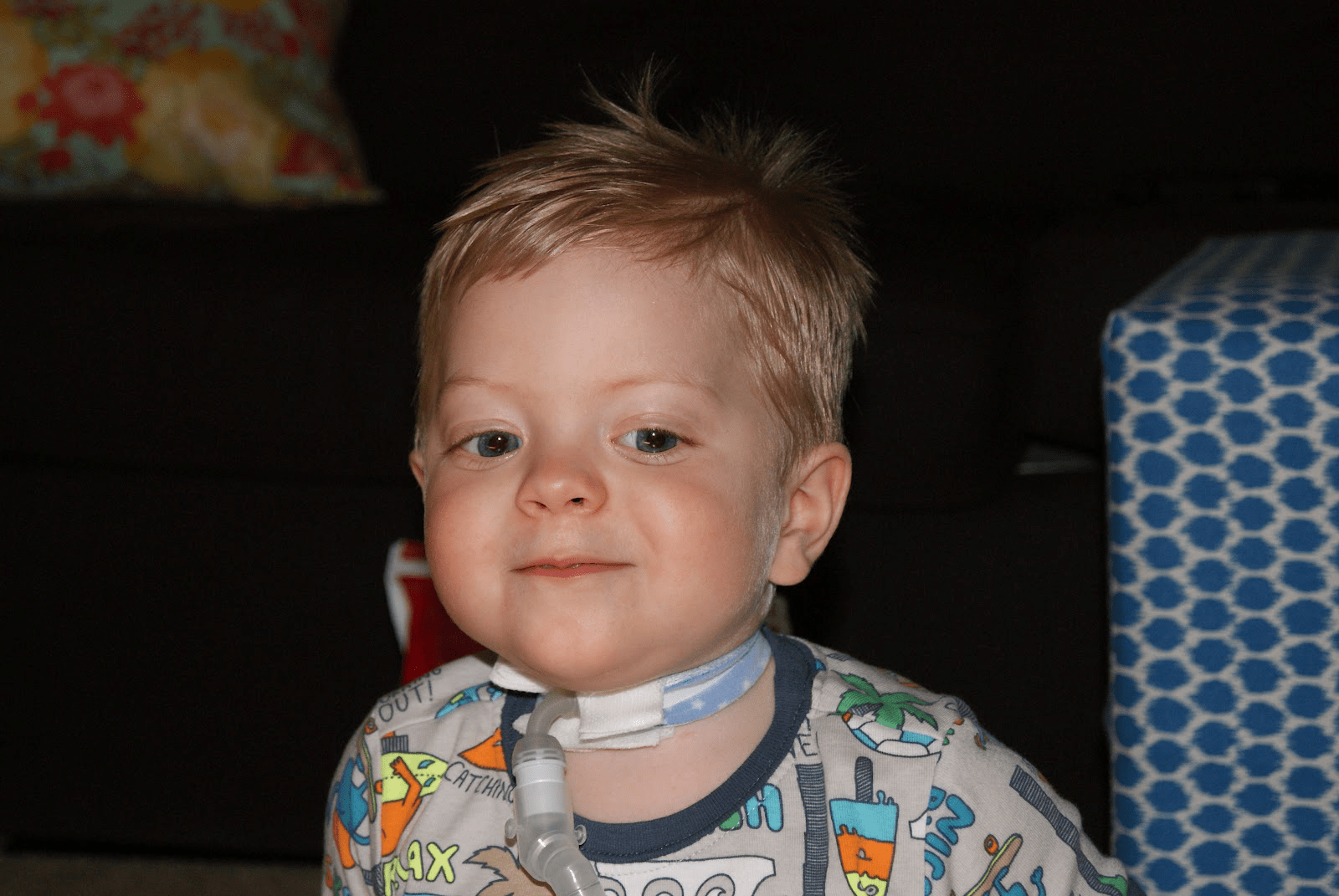
This is a little one born extremely premature at 24 weeks and five days, who spent the first year of life needing ventilation support and CPAP in the NICU (Neonatal Intensive Care Unit) and PICU (Pediatric Intensive Care Unit). Investigations found tracheomalacia and tracheobronchomalacia — essentially a floppy, oversized airway prone to collapse during crying, coughing, or feeding — and prone to recurrent chest infections. That combination led to a tracheostomy alongside ongoing nocturnal CPAP, which has since been able to be ceased overnight — genuine, measurable progress at home.
This child was also fed by a nasogastric tube continuously overnight and by bolus through the day, and lives with a small heart defect and developmental delay across gross motor, fine motor, communication, and cognitive skills. The tracheostomy itself is uncuffed — as is the case for most children — and protrudes at the neck, meaning it is genuinely at risk of being pulled or knocked out by a mobile, crawling toddler who is far too young to understand why they should not touch it. Tracheostomy changes need two people — one to safely distract and hold, and one to change the tracheostomy ties every single day.
None of that — tracheostomy suctioning, emergency insertion of a dislodged tube, recognizing early signs of airway obstruction from sputum plugging — is within the scope of practice of a general registered nurse, a community registered nurse, let alone a disability support worker. It is critical care registered nurse territory, full stop.
We worked with this child for about 18 months until the child could have their tracheostomy removed. Other children have died before it even came to that, because they did not have 24/7 critical care nurses. We have even been approached by one pediatric hospital that admitted to us that a child died in the community who did not have any critical care registered nurses with a tracheostomy, because the disability support workers could not manage a decannulation and seizures — and that is why they brought us on board. To ensure these kids can live at home, ventilated with a tracheostomy, and work towards decannulation — which is exactly what we achieved here.
It is a fantastic case study illustrating how our service not only helps children overcome early-stage life challenges, but enables them to go on to live a normal life.
I know of at least three children who have died under a support worker model with tracheostomies. Unfortunately, the parents did not decide to speak up publicly — but that is the reality.
One of the other things we did with this particular child was managing not only suctioning and nebulizers, but also the nasogastric tube. Children pull out nasogastric tubes. Children pull out their tracheostomy tubes. It is also then a case of reinserting a nasogastric tube at home without needing to go back to the ED (Emergency Department). There are now home X-ray services — big shout out to Michael Montalto and his team at home radiology, and to Simon Jay as well, who make home radiology happen. The infrastructure in the community is being built as we speak by forward-thinking professionals, so that clients do not need to go back to ICU, do not need to go back to hospitals, and do not need to go back to ED. We also work with our own ICU consultant who has experience with adult and pediatric ICU. We are building the infrastructure in real time.
Case Study Number Four: Extremely Premature Baby with Cerebral Palsy, Subglottic Stenosis, and Tracheostomy Dependence
The fourth and last case study in this presentation is another child born extremely premature, who lives with cerebral palsy, acquired subglottic stenosis, and congenital tracheomalacia, and who is tracheostomy-dependent with a small uncuffed tube plus ongoing oxygen requirements. Feeds are entirely via nasogastric tube because of oral aversion and an oral feeding disorder. This child also lives with gastroesophageal reflux and vomiting, and has no functional voice while the tracheostomy was in place.
I am speaking in the past tense here because this child also got decannulated and was discharged from our service — because we helped the child get off the ventilator, get off the tracheostomy, and they no longer needed our service. It is a really extremely encouraging case study for anybody who has a child born prematurely who is now maybe in the NICU or the PICU and wants to go home with a ventilator or tracheostomy. Both of these children were in the NICU and PICU for over 12 months.
This makes exactly the point I want every family, every support coordinator, and every hospital discharge coordinator to hear clearly. A child does not need to be in a controlled ICU or hospital ward for tracheostomy airway risk to be genuinely life-threatening. An active, mobile toddler in an ordinary lounge room with a floppy airway and a tracheostomy tube that can be dislodged by a hand grip or a stray flailing arm needs the same calibre of airway vigilance as a child in a PICU bed or in a NICU. The environment changes. The clinical risk has not changed. But the need for a family and the need for a child to go home is what has also changed.
The Common Thread: The Warning We Cannot Ignore
Every one of these four case studies is different — different age, different diagnosis, different pathway into tracheostomy or ventilator dependence — but every single one needs the same thing: critical care 24 hours a day. Clinical staff who can sense airways, ventilators, tubes, and understand how quickly things can go wrong if they are not planning ahead.
I use this analogy constantly because it is the clearest way I know to explain it. If you would never let a plane fly with a cabin crew but no pilot — cabin crew are wonderful, they are essential, but they cannot fly the airplane — a trained pilot is needed. The ventilator and tracheostomy-dependent client at home, adult or child, without 24/7 critical care registered nurses is exactly that situation.
Noah Johnston
I have to mention Noah Johnston because I will not let this story fade from this conversation. Noah was one of our clients — a young man, ventilator-dependent with a tracheostomy. He had cerebral palsy. He initially had 24-hour NDIS-funded nursing care with critical care nurses. The NDIA (National Disability Insurance Agency) thought it was a good idea to downgrade his level of nursing care from 24 hours a day to 12 hours a day. At the time, his mom Kylie and we as a provider flagged with the NDIA that this was not a good idea, and we flagged that if there was no critical care nurse available 24 hours a day, Noah would die in the absence of a critical care registered nurse.
Unfortunately, we were proven right. Interestingly, his case was waiting at the AAT (Administrative Appeals Tribunal) for a decision on 24-hour nursing care, and his independent clinical assessment as well as independent medical assessment had already warned that his life was at risk without 24/7 critical care. On 8 December 2025, while that funding decision was still being considered at the AAT — and with no critical care nurse present at that moment — he died.
His death was entirely preventable. That is the real world cost of downgrading tracheostomy and ventilator care to a support worker model, or leaving it unfunded while a tribunal deliberates.
Picture this: if a family member is in ICU and the ICU says no more registered nurses, no more critical care registered nurses, we will just send you a support worker — I can guarantee you, after having worked in critical care for over 25 years in three different countries, that all hell would break loose and people would die.
What the Day-to-Day Looks Like
What I have not covered so far in this presentation is what the day-to-day actually looks like. Whether it is for adults or for children, they spend time with their families. They might go out in their wheelchairs, go around the block, maybe take their children to school, or go around the corner to visit other relatives. Relatives might come to them to visit. But this is all happening outside of a hospital and outside of an ICU environment.
For the children, they might go to daycare with a nurse, they might go to kindergarten with a nurse, they might go to school depending on how old they are. We have other pediatric clients that have gone to school or are going to school. None of this stops them from going to school — but they need the 24-hour critical care nurse.
Like I have been saying, we can cut the cost of an ICU bed by approximately 50% with Intensive Care at Home. An ICU bed costs around $5,000 to $10,000 per bed day. Intensive Care at Home is approximately 50% of that cost. But you cannot cut the cost of an ICU by 70% — meaning you cannot send disability support workers instead of ICU nurses — or potentially even 80%. That is simply not feasible and not safe.
NDIS Support Coordination and Funding Advocacy
Beyond direct nursing, Intensive Care at Home also provides Level 2 and Level 3 NDIS support coordination as well as TAC and WorkSafe case management. If you are a family trying to navigate an NDIS plan, increase an NDIS plan, get an NDIS plan to begin with, fight for the right level of funding, or manage a TAC or WorkSafe claim involving ventilation, tracheostomy, or complex nursing needs — which could include a traumatic or acquired brain injury, spinal injuries, or other complexity — this is exactly the kind of coordination support that stops you from having to fight the system entirely on your own.
One of the most powerful things any family can do is request copies of medical records, discharge summaries, nursing assessments, and independent clinical reports — and use them in writing to advocate for the correct level of funded nursing care. Every one of the four case studies above exists on paper as a discharge summary, a nursing assessment, and an independent clinical report — precisely because that documentation is what turns “my loved one needs more support” into an evidence-based funding case that the NDIS, the AAT, WorkSafe, or DVA (Department of Veterans’ Affairs) cannot easily dismiss.
If a funding body is offering a disability support worker instead of a critical care registered nurse — or offering a registered nurse instead of a critical care registered nurse for a tracheostomy or ventilator-dependent loved one — do not just accept it. Document your objection in writing, escalate it, and reach out to us because we can help you with that very level of escalation. We know what documents need to go to a funding body to help you secure the right level of funding.
I also highly encourage you to get access to your family member’s medical records. If you do not have access to the medical records, you are almost flying blind. As clinicians, we cannot really do anything without medical records — so it is very important for you to get access to them. Any funding body will also want to see the medical records. They are not going to fund anything without looking at at least some of the medical records. As much as I am saying those funding bodies are run by non-clinicians, the evidence still needs to be there.
This is again where our Level 2 and Level 3 NDIS support coordination comes in.
Questions and Answers
Every client at home lives their best possible life. Compare that to a hospital ICU bed — there is no quality of life in a hospital ICU bed. In ICU, patients are often labelled as: “oh yeah, they won’t have any quality of life, they should have a DNR (Do Not Resuscitate) or an NFR (Not For Resuscitation) order” — meaning if their heart stops, they should just pass away. And that is simply not good enough, because people want to live. Life is precious.
Question from Andrew: Is it actually safe to have a ventilator-dependent, tracheostomy-dependent person living at home?
Yes, absolutely but only if it is staffed correctly with the right level of skill. Your family member needs critical care nurses similar to an ICU staffing model. Mechanical home ventilation is established, evidence-based practice used for decades in Germany, Austria, Switzerland, and now Australia. Safety does not come from being in a hospital building. It comes from the right mindset, the right structure, and having critical care registered nurses 24 hours a day who know what they are doing — especially when it comes to ventilation and tracheostomy. That is covered in full in our Mechanical Home Ventilation Guidelines at intensivecareathome.com.
Question from Bernardine: What is the difference between invasive and non-invasive ventilation?
Invasive ventilation goes through a tracheostomy or through a breathing tube in the mouth — but in home ventilation, it is almost always a tracheostomy when it comes to invasive ventilation. A tracheostomy is a surgical airway in the neck connected to a ventilator. Non-invasive ventilation — BiPAP and CPAP — is delivered through a mask over the nose or face, with no surgical airway involved. Both can be full-time or part-time, and both require 24/7 critical care nurses if the person is dependent on them.
Question from Veronica: Why can a general registered nurse or disability support worker not manage a tracheostomy or ventilator?
Because it is simply not in their scope of practice or training. Registered nurses without ICU experience — let alone disability support worker courses — do not include complex or advanced airway management. I have named several of the major skills required for ICU, and none of the training for disability support workers or registered nurses without ICU experience includes ICU training. You cannot train a disability support worker on ICU skills without them having done basic nurse training first. Suctioning, recognizing airway obstruction, reinserting a dislodged tube, managing a deflated tracheostomy cuff — that is critical care territory. It is the pilot in the cockpit analogy. Cabin crew are wonderful, but they cannot fly the airplane.
Question from Tracy: What actually happened to Noah Johnston?
Noah was a very tragic case. Noah was one of our clients — ventilator-dependent with a tracheostomy. He had cerebral palsy. His NDIS-funded 24-hour nursing was downgraded to day shifts only while his case for 24-hour critical care nursing was waiting at the AAT. Despite independent medical and nursing assessments already warning that his life was at risk without 24/7 critical care nursing, the hearing at the AAT was only meant to happen in March 2026. Unfortunately, Noah passed away on 8 December 2025 because funding was cut and no critical care nurse was present. Nobody knew how to manage a dislodged or disconnected ventilator from the tracheostomy. His tracheostomy dislodged with no critical care nurse present — and he died. It was entirely preventable, and it is why I keep telling his story — to also hold the NDIA accountable so that no other client is ever in a similar situation again.
Thank you everyone for watching. Like the video, subscribe to my YouTube channel, click the notification bell, comment below, and share the video with anyone who would benefit from today’s video — anyone who has a loved one in ICU or has a loved one at home with insufficient support.
Contact us at intensivecareathome.com. Call us on one of the numbers on the top of our website, or book a call with me directly via the Schedule Appointment button. You can also email me at [email protected]. We are currently operating all around Australia in all states and territories. We are third-party accredited and NDIS registered. I look forward to hearing from you. Take care for now.
With all of that said, with Intensive Care at Home, we are currently sending our critical care nurses into the home 24 hours a day. Therefore, we are providing a genuine alternative to long-term stay in intensive care for:
- Ventilation
- Tracheostomy
- Home BiPAP (Bilevel Positive Airway Pressure) and CPAP (Continuous Positive Airway Pressure)
- Tracheostomy care without ventilation
- home TPN (Total Parenteral Nutrition)
- Home IV potassium
- Home IV magnesium
- Home IV antibiotics
- Home IV fluids
We’re providing:
- Cough assist management at home
- Ventilation weaning management at home
- central line, PICC (Peripherally Inserted Central Catheter) line, Hickman’s line as well as port management at home
- nasogastric tube, nasojejunostomy tube, PEG (Percutaneous Endoscopic Gastrostomy), PEJ (Percutaneous Endoscopic Jejunostomy) tube management at home
- IDC (Indwelling Catheter) and SPC (Suprapubic Catheter) management at home
- Palliative care services at home
We’re also sending our critical care nurses into the home for emergency department bypass services. We have done so successfully as part of the Western Sydney Local Health District’s In Touch program, saving approximately $2,000 per patient that we keep at home instead of them going into an emergency department.
That also means we’re in a position to cut the cost of an ICU bed by around 50%. An intensive care bed costs between $5,000 to $10,000 per bed day depending on location. Intensive Care at Home costs approximately 50% of that, and we’re freeing up the most sought-after bed in the hospital, which is the ICU bed. Most importantly, we’re improving the quality of life for patients and their families, which is a win-win situation for all stakeholders.
Our Coverage and Accreditation
With Intensive Care at Home, we’re currently operating all around Australia, in all major capital cities, as well as in all regional and rural areas. We are an NDIS approved service provider all around Australia, TAC (Transport Accident Commission) and WorkSafe in Victoria as well as the Department of Veterans Affairs all around Australia.
We’re also ISO 9001:2015 accredited. Our clients and we as a service provider have also received funding through public hospitals, private health funds as well as departments of health.
We are the only service provider in Australia that has achieved third-party accreditation for Intensive Care at Home nursing in 2025. We have been achieving this high level of accreditation since 2012. No other provider in Australia has achieved the Intensive Care at Home level of accreditation in the community and has created more intellectual property when it comes to Intensive Care at Home nursing than we have.
This puts us in a position to employ hundreds of years of critical care nursing experience combined in the community. No other service provider in 2025 employs a higher skill level in the community than we do. And that enables us to look after the highest acuity adults and children in the community in Australia safely.
If You Need Help
If you’re at home already and you’re watching this or you’re stuck in an ICU and you realize that you don’t have the right level of support, I can give you many examples where we helped clients with funding, how we advocate for funding. We had to advocate successfully for funding from our first case study to many other case studies where we had to advocate successfully for funding with the right evidence of course because it is crystal clear that disability support workers for example or registered nurses without ICU experience cannot look after ventilated clients at home whether adults or children with or without a tracheostomy and it’s simply dangerous and negligent.
There are plenty of examples where clients with support worker models or even RN (registered nurse) models without ICU experience have died at home and I have evidence to back up everything that I’m saying here because it’s a bit like flying the airplane with a cabin crew instead of the pilot and it could simply be deadly.
This can be avoided by having simply 24-hour critical care nurses at home because our clients are at high risk of medical emergencies or worse without critical care nurses 24 hours. This is actually also evidence-based in the community and is documented in our evidence-based Mechanical Home Ventilation Guidelines on our website at intensivecareathome.com.
Think about it: in an intensive care unit in a hospital, you wouldn’t have support workers or general registered nurses looking after a critical care patient on a ventilator with a tracheostomy. So why would anyone in their right mind do that in a home care environment where there are fewer resources?
Clients that have found us have been at home long-term predictably and permanently with critical care nurses. Their alternative would have been to either die or stay in ICU long-term, and our clients don’t go back to ICU. They stay at home permanently and predictably and the insurance bodies save half of the cost of an ICU. But it’s a win-win situation all around.
We can do the same for you if you’re stuck in ICU or if you’re not safe at home, which includes the advocacy for funding and the network that goes along with it. We have always successfully advocated for our clients or we have the network to successfully advocate for you and for your family member, otherwise we wouldn’t be in business. The same again is applicable for those stuck in an ICU which is similar to many of our, if not most of our cases.
Our Support Coordination Services
This is also why we are providing Level 2 and Level 3 NDIS support coordination. We have a team of experienced NDIS support coordinators, and they have a wealth of knowledge. We’re also providing TAC case management and WorkSafe case management in Victoria with Lucy McCotter.
If you’re an NDIS support coordinator or a case manager or a social worker from another organization or a hospital watching this and you’re looking for nursing care for your participants, please reach out to us as well. If you’re looking for funding for nursing care for your participants and you don’t know how to go about it and how to advocate for it, what evidence to provide, I encourage you to reach out to us as well. We have the network to make that happen. We will help you with the right level of funding and with the right level of advocacy.
We’re also providing NDIS specialist nursing assessments done by critical care nurses with a legal nurse consulting background.
Join Our Team
If you are a critical care nurse and you’re looking for a career change and you want to join a very progressive, dynamic, successful, and high-performing team of critical care nurses in the community, we are employing hundreds of years of critical care nursing experience combined.
If you’re looking for a career change, we’re currently hiring for jobs for critical care nurses in Melbourne, Sydney, Brisbane, Albury-Wodonga, Bendigo, Geelong, Warragul, and also in Wyelangta in Victoria.
If you have worked in critical care nursing for a minimum of two years, adult ICU, pediatric ICU, ED and you have already completed a postgraduate critical care nursing qualification, we will be absolutely delighted hearing from you.
I have a disclaimer though: Because we are offering tailor-made solutions for our clients which includes regular staff, our clients do also want the same staff coming over and over again because they are so vulnerable and so special. That’s why we need regular, reliable staff.
If you’re looking for agency work where you can come and go, this will not be the right fit for you. We’re looking for consistency and our clients are looking for consistency. So please only apply with us if you can give us regular and consistent availabilities for shifts and you’re really keen on building relationships with us and with our clients. Reliability is also a must.
For Medical Professionals and Healthcare Executives
If you’re an intensive care specialist or an ED specialist, we also want to hear from you. We’re currently expanding our medical team as well.
We can also help you eliminate your bed blocks in your ICU and in your ED for your long-term patients or for your regularly readmitting patients with our critical care nursing team at home. We’re here to help to take the pressure off your ICU and ED beds. In most cases, you won’t even pay for it. Even if you do pay for it, it is so much more cost-effective than what you’re paying for in ICU and ED settings, and you get the same level of care and simply more patient and family satisfaction because you also want to partner with your consumers.
If you are a hospital executive watching this, we can help you free up your ICU and ED beds.
International Support
If you’re in the U.S. or in the UK and you’re watching this and you need help, we want to hear from you as well. We can help you there privately with one-on-one consulting and with hiring nurses privately.
Once again, our website is intensivecareathome.com. Call us on one of the numbers on the top of our website or simply send us an email to [email protected].
If you like my videos, click the like button, subscribe to my YouTube channel for regular updates for families with Intensive Care at Home and intensive care. Click the like button, click the notification bell, and share this video with anyone who has a family member in intensive care long-term or needs to see this.
Thank you so much for watching.
This is Patrik Hutzel from intensivecareathome.com and I’ll talk to you in a few days.
Take care for now.
RELATED LINKS:
 Why specialized services for Long-term ventilated adults and children with Tracheostomy outside of Intensive Care in the community are becoming a vital necessity!
INTENSIVE CARE AT HOME is it evidence based?
ARE INTENSIVE CARE UNITS OPERATING IN A VACUUM WHEN IT COMES TO END OF LIFE SITUATIONS?
Is looking after long-term ventilated Patients with tracheostomies in Intensive Care “best practice”?
Why specialized services for Long-term ventilated adults and children with Tracheostomy outside of Intensive Care in the community are becoming a vital necessity!
INTENSIVE CARE AT HOME is it evidence based?
ARE INTENSIVE CARE UNITS OPERATING IN A VACUUM WHEN IT COMES TO END OF LIFE SITUATIONS?
Is looking after long-term ventilated Patients with tracheostomies in Intensive Care “best practice”?
 Freeing up hospital beds—how children can leave hospital sooner!