Podcast: Play in new window | Download
My name is Patrik Hutzel from Intensive Care at Home at intensivecareathome.com, where we provide tailor-made solutions for long-term ventilated adults and children at home with tracheostomy and ventilator support 24/7 with critical care nurses, where we provide the same at home for long-term ventilated adults and children on BiPAP (Bilevel Positive Airway Pressure) and CPAP (Continuous Positive Airway Pressure) ventilation without tracheostomy, where we provide 24/7 critical care registered nurses at home for tracheostomy without ventilation for adults and for children, home ventilation and home tracheostomy weaning when medically appropriate at home, cough assist management at home, home TPN (Total Parenteral Nutrition), home IV fluids, home IV antibiotics, home IV potassium, magnesium and other electrolyte infusions at home. We provide central line, PICC (Peripherally Inserted Central Catheter) line, Hickman’s line, and port management at home, IDC (Indwelling Catheter) and SPC (Suprapubic Catheter) management, nasogastric tube and nasojejunostomy tube, PEG (Percutaneous Endoscopic Gastrostomy) and PEJ (Percutaneous Endoscopic Jejunostomy) tube management at home, as well as palliative care management at home. We also provide Level 2 and Level 3 NDIS (National Disability Insurance Scheme) support coordination as well as WorkSafe and TAC (Transport Accident Commission) case management.
Today I want to talk about a story from Queensland that made headlines last month. By the time of publishing this video it will be September. The article was in the Courier Mail on the 6th of August, and it is a story that makes me very angry and frustrated. It is about a father of three called Aaron Reardon. He has Motor Neurone Disease which is also known as MND. A tracheostomy that could give him years more with his kids and his family and a hospital system that said no.
If you or someone you love is living with MND, ALS (Amyotrophic lateral sclerosis), or facing decisions about invasive ventilation with tracheostomy, non-invasive ventilation on BiPAP or CPAP, or tracheostomy care without ventilation, this is a story you need to understand.
Aaron Reardon’s Story: Blocked from a Procedure That Could Buy Him Years
Aaron Reardon is a father of three from Buccan, south of Brisbane. He is living with MND and spent six months working with specialists at Princess Alexandra Hospital in Brisbane to prepare for an elective tracheostomy. When the decision came back, it was a refusal. His wife Beck and their children were left devastated.
And Aaron is not an isolated case. Brisbane man Andy Taylor was diagnosed with MND in 2021 and, unable to get a tracheostomy in Queensland, traveled to London in 2023 to have the procedure done. He said the surgery let him live longer and far more comfortably than non-invasive ventilation alone ever could. Cameron McPherson, a 69-year-old Brisbane man who has lived with MND for nine years, has made the point that matters most here: this is a deeply personal decision, and people with MND deserve accurate information, respect for their autonomy, and the right to choose.
As of July 2026, Metro South Health in Brisbane was providing care to 76 MND patients across the Metro South and West Moreton regions of Queensland. Not one of them has a tracheostomy.
Before I go to the next chapter of this video — why hospitals say no and why the quality-of-life argument does not hold up — I also want to tell you what makes me qualified to talk about this subject.
I have worked in critical care nursing for over 25 years in three different countries, where I have worked as a nurse manager for over five years in intensive care. I founded Intensive Care at Home here in Australia in 2012, knowing full well that there was a gap in the market to serve patients like Aaron or Andy Taylor at home with ventilation and tracheostomy, instead of keeping them in ICU. My goal has always been to provide choice and control for patients and families, but also for ICUs so that patients do not block beds in ICU for long periods of time.
My experience with Intensive Care at Home comes from the early 2000s in Germany, where I was part of setting up Intensive Care at Home — a pioneering service. Big shout out to Brambring and Jaschke in Munich. That is where I learned the ropes about Intensive Care at Home. When I first came to Australia in 2012, I saw a big gap in the market. Many intensive care patients that would be at home in Germany were blocking beds in Australia. Also, many patients that would be at home in Germany died in ICU in Australia because of the lack of perceived options. I see decisions being made about life or death without contemplating services like Intensive Care at Home, and that led me down this path. I can very confidently say that we have saved many lives and prolonged many lives with Intensive Care at Home in the community, and you can verify that on our testimonial section at intensivecareathome.com.
We also provide a consulting and advocacy service for families in intensive care to help patients like Aaron, and you can find more information at intensivecarehotline.com. To round out my experience, I have looked after many MND patients in a homecare setting with tracheostomy and ventilation in Germany in the early 2000s, and we also have MND clients with tracheostomy here at Intensive Care at Home.
So the argument from Metro South that Aaron does not deserve a tracheostomy — that it cannot be done, that there is no quality of life — is complete nonsense. As Cameron McPherson said, it is a deeply personal decision to be made. Tracheostomy is not for all MND patients. It really depends on your beliefs and your circumstances — and that is what it comes down to — not on a hospital’s perception about what quality of life might be, because quality of life is subjective. It is not an objective measure.
There are plenty of case studies out there, whether in Europe or in Australia, showing that patients can live a very good quality of life with ventilation and tracheostomy and MND — as long as they have 24-hour critical care registered nurses, which they do have with our service, which is NDIS-funded.
Why Hospitals Say No — and Why the Quality of Life Argument Does Not Hold Up
In Aaron’s case, Princess Alexandra Hospital in Brisbane told his family that while a tracheostomy might extend his lifespan, the clinical evidence does not show a matching improvement in quality of life, and pointed to long-term risks and the chance of complications. I have heard this argument for years in different forms and I want to be direct with you — it does not stack up against the evidence.
I trained and worked as a critical care registered nurse in Germany, in the UK, and in Australia before I started Intensive Care at Home. In Germany, tracheostomy ventilation for MND patients, supported at home by 24/7 critical care registered nurses — which, by the way, is evidence-based — has been standard practice since the late 1990s, not a rare last-resort intervention. Decades of that experience tell a very different story to what Queensland families are being told. With the right nursing model — which is 24/7 critical care registered nurses, not general registered nurses, not enrolled nurses, not disability support workers — patients with a tracheostomy and MND go on to live full lives at home, involved with their families, their communities, and in some cases still working.
Another important point: Professor Stephen Hawking had a tracheostomy in 1985 and lived with MND for 55 years. He did not survive because he was exceptional as a person. He survived because he had access to the procedure and to skilled, around-the-clock 24/7 critical care registered nurses. That is not a miracle. That is what happens when patients are given the option, the opportunity, and the right nursing support.
And just the economics behind that: an intensive care bed costs around $5,000 to $10,000 per bed day. A patient with a tracheostomy ends up there, and Intensive Care at Home cuts the cost of an intensive care bed by around 50%. Who are hospitals to say who lives and dies? From my perspective as a Christian, it is up to God who lives and dies — and not up to hospital authorities. Our job as clinicians is to make sure that people have the option to live if they want to live. Coming back to the quality of life argument — from my perspective, it is life over quality of life. You may disagree with that and I am perfectly fine with that — you can leave your comments. But MND clients on tracheostomy or on BiPAP live with a good quality of life because they want to be here. You can ask our clients.
Is Voluntary Assisted Dying Being Offered Instead of Life-Prolonging Care and Tracheostomy?
One of the more troubling claims to come out of this story with Aaron is that VAD (Voluntary Assisted Dying) is being raised with MND patients more readily than treatments that could extend or improve their lives. If that is happening anywhere in our health system, it should not be normalized. A patient with MND deserves the same access to life-prolonging treatment that a patient with stage 4 cancer or any other terminal diagnosis would be offered. No one should feel steered towards voluntary assisted dying because the system is not funded or resourced to offer the alternative. That is a very nihilistic approach. I am all for preserving life even if it comes at the cost of quality of life.
I have never been a friend of VAD. I do believe it opens the doors for a slippery slope for exactly a situation like this — where we offer VAD instead of alternative proven treatments that have been around in other countries for 30 years.
The Petition: What Aaron’s Family Is Asking For
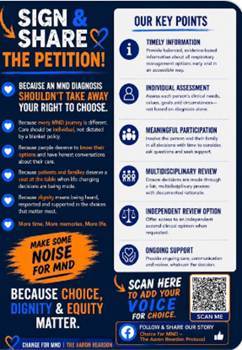
Beck Reardon and other MND families have put together a parliamentary petition calling on the Queensland government to give patients the right to choose tracheostomy ventilation and to support clinicians to make consistent, evidence-informed decisions about life-prolonging care for people with MND. I support this petition and I ask you to do as well.
It is not about forcing surgery on anyone. It is about giving people like Aaron, Andy, and Cameron the same right to choose that any other patient with a terminal illness already has.
I have put a link in the show notes in the article below the video where you can click on the link and sign the petition to the Queensland Parliament. It takes two minutes. Please also share it with your own networks. The more signatures this petition has, the harder it is for Queensland to ignore. If you want to stay across what happens next, subscribe to our email list and YouTube channel at intensivecareathome.com.
Ian Haywood: Australia’s Longest-Living Tracheostomy Client with MND
I also want to introduce you to one of our long-term clients at Intensive Care at Home — actually the longest-living MND client we have supported in Australia. He has been one of our clients since 2019. The client was diagnosed with MND in 2016 and ended up in ICU in 2019, where he needed a tracheostomy because he had an aspiration pneumonia. According to his family, Ian Haywood is the longest-living tracheostomy client with MND in Australia — and that is because he has 24-hour critical care registered nurses. That is because he has a supportive family. That is because he wants to live.
Unfortunately, the client is now non-verbal and communicates through eye movement and a computer. He can operate with a button under his wrist, but he remains very involved in local political advocacy where he lives. He watches films, reads books, and enjoys time with his family. I also insert an article about the client in the show notes because he has also been featured in the media as part of NDIS advocacy — because in 2021, the NDIS attempted to cut the client’s 24-hour nursing funding down to just six hours a day, on the basis that his care would be delivered by a disability support worker instead of a nurse, for someone who is fully ventilator-dependent with a tracheostomy. That is not a funding adjustment. It is a direct threat to his safety and his life, and it could have been a death sentence. The client and his family fought that very decision because the client wants to live — and with 24/7 critical care registered nurses and NDIS funding in place, he has been able to keep on living on his terms at home.
Ian’s story is the real answer to the quality of life argument being used to deny Aaron Reardon his tracheostomy. Quality of life with a tracheostomy is not determined by the tube itself. It is determined by whether a patient has skilled, consistent, third-party accredited Intensive Care at Home nursing service 24/7 critical care registered nurses managing their airway and their ventilation — whether that is invasive ventilation with tracheostomy, non-invasive ventilation by BiPAP or CPAP, or even tracheostomy care without ventilation when it comes to conditions outside of MND.
I describe this the same way every single time. It has to be critical care registered nurses for ventilation with tracheostomy — not general registered nurses, not enrolled nurses, and definitely not disability support workers — because too many patients have passed away, including Noah Johnston, as reported in the Daily Telegraph, where the NDIS was cutting funding for a ventilated tracheostomy client and he passed away while we were not there — just as we predicted.
It comes down to this: you would not want the cabin crew to fly an airplane who has never trained on that aircraft. You want a trained pilot to fly the airplane. The same principle applies to invasive ventilation, non-invasive ventilation, and tracheostomy care at home. These are not tasks you can safely hand to a general registered nurse, to an enrolled nurse, or to a disability support worker with a few hours or no training at all.
Clients like Ian Haywood or Aaron Reardon need 24/7 critical care registered nurses who have worked in intensive care for at least two years and can recognize the early signs of a blocked tube, a chest infection, or a ventilator malfunctioning before it turns into an emergency. This is the model I brought back from my years working in ICUs and intensive care at home in Germany and the UK, and it is the model we have built Intensive Care at Home around since 2012 here in Australia.
Why Intensive Care at Home?
If you or a family member is weighing up decisions about mechanical ventilation at home — invasive ventilation with tracheostomy, non-invasive ventilation with BiPAP, or tracheostomy care without ventilation for adults and for children — I would strongly encourage you to read our evidence-based Mechanical Home Ventilation Guidelines on our website at intensivecareathome.com, because this is exactly the kind of information families need before sitting down with a hospital’s MDT (Multidisciplinary Team).
Why Intensive Care at Home? Because we are Australia’s only third-party accredited specialist home ICU nursing provider — ISO 9001:2015 certified as well as NDIS registered. You can see our quality and safety standards on our website at intensivecareathome.com/accreditation-quality.
We provide 24/7 critical care registered nurses for invasive ventilation with tracheostomy, non-invasive ventilation on BiPAP, and tracheostomy care without ventilation — and everything that goes along with that, which could be TPN, IV fluids, IV antibiotics, PEG and PEJ tubes, nasogastric tubes, SPC, IDC, and more. We also provide Level 2 and Level 3 NDIS support coordination as well as TAC and WorkSafe case management — so families are not left to fight funding battles like the one Ian Haywood faced or the one Aaron Reardon’s family is facing right now, on their own.
The Bottom Line
Aaron Reardon, Andy Taylor, Cameron McPherson, Ian Haywood, and many others should not have to fight this hard just to be allowed to live. The decades of clinical experience out of Germany with MND clients on ventilation with tracheostomy — instead of a long-term stay in intensive care or letting people die — the example of Stephen Hawking, who lived for decades on ventilation with tracheostomy and MND, and the lived reality of our own clients, which includes Ian Haywood but also others, all point to the same conclusion: tracheostomy ventilation for MND patients, backed by 24/7 critical care registered nursing, works.
The quality of life argument being used to deny these patients surgery is not backed by decades of international clinical experience. It is backed by a system that is not resourced or willing to fund the nursing model that makes it possible.
If you or someone you love is living with MND or any similar condition requiring invasive ventilation with tracheostomy, non-invasive ventilation with BiPAP, or tracheostomy care without ventilation, and you want to explore what 24/7 critical care registered nurses at home care can do for you, or you need help navigating funding with NDIS, DVA (Department of Veterans’ Affairs), WorkSafe, or others — reach out to us. You can reach out to me directly on our website at intensivecareathome.com. You can call us on one of the numbers on the top of our website, book a call with me by clicking the Schedule Appointment button, or you can call me directly if you are in Australia on my mobile on 0410 942 230 — that is again 0410 942 230.
If you are in the US, in Canada, in the UK, in India, or in any other country around the world, reach out to us as well and we can help you there too.
Subscribe to my YouTube channel, subscribe to my email list, share the video with friends and families, leave your comments if you agree or disagree, and share your experience. And before you go, please sign Aaron Reardon’s petition to the Queensland Parliament by clicking on the link. It costs you two minutes and it could change how Queensland treats every MND patient who wants the choice to live going forward.
With all of that said, with Intensive Care at Home, we are currently sending our critical care nurses into the home 24 hours a day. Therefore, we are providing a genuine alternative to long-term stay in intensive care for:
- Ventilation
- Tracheostomy
- Home BiPAP (Bilevel Positive Airway Pressure) and CPAP (Continuous Positive Airway Pressure)
- Tracheostomy care without ventilation
- home TPN (Total Parenteral Nutrition)
- Home IV potassium
- Home IV magnesium
- Home IV antibiotics
- Home IV fluids
We’re providing:
- Cough assist management at home
- Ventilation weaning management at home
- central line, PICC (Peripherally Inserted Central Catheter) line, Hickman’s line as well as port management at home
- nasogastric tube, nasojejunostomy tube, PEG (Percutaneous Endoscopic Gastrostomy), PEJ (Percutaneous Endoscopic Jejunostomy) tube management at home
- IDC (Indwelling Catheter) and SPC (Suprapubic Catheter) management at home
- Palliative care services at home
We’re also sending our critical care nurses into the home for emergency department bypass services. We have done so successfully as part of the Western Sydney Local Health District’s In Touch program, saving approximately $2,000 per patient that we keep at home instead of them going into an emergency department.
That also means we’re in a position to cut the cost of an ICU bed by around 50%. An intensive care bed costs between $5,000 to $10,000 per bed day depending on location. Intensive Care at Home costs approximately 50% of that, and we’re freeing up the most sought-after bed in the hospital, which is the ICU bed. Most importantly, we’re improving the quality of life for patients and their families, which is a win-win situation for all stakeholders.
Our Coverage and Accreditation
With Intensive Care at Home, we’re currently operating all around Australia, in all major capital cities, as well as in all regional and rural areas. We are an NDIS approved service provider all around Australia, TAC (Transport Accident Commission) and WorkSafe in Victoria as well as the Department of Veterans Affairs all around Australia.
We’re also ISO 9001:2015 accredited. Our clients and we as a service provider have also received funding through public hospitals, private health funds as well as departments of health.
We are the only service provider in Australia that has achieved third-party accreditation for Intensive Care at Home nursing in 2025. We have been achieving this high level of accreditation since 2012. No other provider in Australia has achieved the Intensive Care at Home level of accreditation in the community and has created more intellectual property when it comes to Intensive Care at Home nursing than we have.
This puts us in a position to employ hundreds of years of critical care nursing experience combined in the community. No other service provider in 2025 employs a higher skill level in the community than we do. And that enables us to look after the highest acuity adults and children in the community in Australia safely.
If You Need Help
If you’re at home already and you’re watching this or you’re stuck in an ICU and you realize that you don’t have the right level of support, I can give you many examples where we helped clients with funding, how we advocate for funding. We had to advocate successfully for funding from our first case study to many other case studies where we had to advocate successfully for funding with the right evidence of course because it is crystal clear that disability support workers for example or registered nurses without ICU experience cannot look after ventilated clients at home whether adults or children with or without a tracheostomy and it’s simply dangerous and negligent.
There are plenty of examples where clients with support worker models or even RN (registered nurse) models without ICU experience have died at home and I have evidence to back up everything that I’m saying here because it’s a bit like flying the airplane with a cabin crew instead of the pilot and it could simply be deadly.
This can be avoided by having simply 24-hour critical care nurses at home because our clients are at high risk of medical emergencies or worse without critical care nurses 24 hours. This is actually also evidence-based in the community and is documented in our evidence-based Mechanical Home Ventilation Guidelines on our website at intensivecareathome.com.
Think about it: in an intensive care unit in a hospital, you wouldn’t have support workers or general registered nurses looking after a critical care patient on a ventilator with a tracheostomy. So why would anyone in their right mind do that in a home care environment where there are fewer resources?
Clients that have found us have been at home long-term predictably and permanently with critical care nurses. Their alternative would have been to either die or stay in ICU long-term, and our clients don’t go back to ICU. They stay at home permanently and predictably and the insurance bodies save half of the cost of an ICU. But it’s a win-win situation all around.
We can do the same for you if you’re stuck in ICU or if you’re not safe at home, which includes the advocacy for funding and the network that goes along with it. We have always successfully advocated for our clients or we have the network to successfully advocate for you and for your family member, otherwise we wouldn’t be in business. The same again is applicable for those stuck in an ICU which is similar to many of our, if not most of our cases.
Our Support Coordination Services
This is also why we are providing Level 2 and Level 3 NDIS support coordination. We have a team of experienced NDIS support coordinators, and they have a wealth of knowledge. We’re also providing TAC case management and WorkSafe case management in Victoria with Lucy McCotter.
If you’re an NDIS support coordinator or a case manager or a social worker from another organization or a hospital watching this and you’re looking for nursing care for your participants, please reach out to us as well. If you’re looking for funding for nursing care for your participants and you don’t know how to go about it and how to advocate for it, what evidence to provide, I encourage you to reach out to us as well. We have the network to make that happen. We will help you with the right level of funding and with the right level of advocacy.
We’re also providing NDIS specialist nursing assessments done by critical care nurses with a legal nurse consulting background.
Join Our Team
If you are a critical care nurse and you’re looking for a career change and you want to join a very progressive, dynamic, successful, and high-performing team of critical care nurses in the community, we are employing hundreds of years of critical care nursing experience combined.
If you’re looking for a career change, we’re currently hiring for jobs for critical care nurses in Melbourne, Sydney, Brisbane, Albury-Wodonga, Bendigo, Geelong, Warragul, and also in Wyelangta in Victoria.
If you have worked in critical care nursing for a minimum of two years, adult ICU, pediatric ICU, ED and you have already completed a postgraduate critical care nursing qualification, we will be absolutely delighted hearing from you.
I have a disclaimer though: Because we are offering tailor-made solutions for our clients which includes regular staff, our clients do also want the same staff coming over and over again because they are so vulnerable and so special. That’s why we need regular, reliable staff.
If you’re looking for agency work where you can come and go, this will not be the right fit for you. We’re looking for consistency and our clients are looking for consistency. So please only apply with us if you can give us regular and consistent availabilities for shifts and you’re really keen on building relationships with us and with our clients. Reliability is also a must.
For Medical Professionals and Healthcare Executives
If you’re an intensive care specialist or an ED specialist, we also want to hear from you. We’re currently expanding our medical team as well.
We can also help you eliminate your bed blocks in your ICU and in your ED for your long-term patients or for your regularly readmitting patients with our critical care nursing team at home. We’re here to help to take the pressure off your ICU and ED beds. In most cases, you won’t even pay for it. Even if you do pay for it, it is so much more cost-effective than what you’re paying for in ICU and ED settings, and you get the same level of care and simply more patient and family satisfaction because you also want to partner with your consumers.
If you are a hospital executive watching this, we can help you free up your ICU and ED beds.
International Support
If you’re in the U.S. or in the UK and you’re watching this and you need help, we want to hear from you as well. We can help you there privately with one-on-one consulting and with hiring nurses privately.
Once again, our website is intensivecareathome.com. Call us on one of the numbers on the top of our website or simply send us an email to [email protected].
If you like my videos, click the like button, subscribe to my YouTube channel for regular updates for families with Intensive Care at Home and intensive care. Click the like button, click the notification bell, and share this video with anyone who has a family member in intensive care long-term or needs to see this.
Thank you so much for watching.
This is Patrik Hutzel from intensivecareathome.com , and I’ll talk to you in a few days.
Take care for now.
RELATED LINKS:
 How to improve a niche within Intensive Care
How to take control if your loved one has a severe brain injury and is critically ill in Intensive Care
How to better manage limited resources in Intensive Care!
HOW TO SELECT THE BEST OPTIONS WHEN YOUR LOVED ONE IS STUCK IN ICU ON A VENTILATOR WITH TRACHEOSTOMY!
How to make Intensive Care more Patient and family friendly!
How to improve a niche within Intensive Care
How to take control if your loved one has a severe brain injury and is critically ill in Intensive Care
How to better manage limited resources in Intensive Care!
HOW TO SELECT THE BEST OPTIONS WHEN YOUR LOVED ONE IS STUCK IN ICU ON A VENTILATOR WITH TRACHEOSTOMY!
How to make Intensive Care more Patient and family friendly!