Podcast: Play in new window | Download
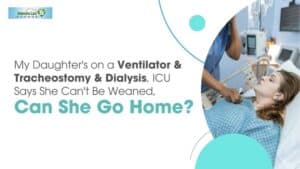
My Daughter’s on a Ventilator & Tracheostomy & Dialysis, ICU Says She Can’t Be Weaned, Can She Go Home?
Hi, it’s Patrik Hutzel from intensivecareathome.com where we provide tailor-made solutions for long-term ventilated adults and children with tracheostomies and where we also provide tailor-made solutions for hospitals and intensive care units whilst providing quality services for long-term ventilated adults and children with tracheostomies, also otherwise medically complex adults and children at home, including Home BIPAP (bilevel positive airway pressure), Home CPAP (continuous positive airway pressure), also home tracheostomy care when adults and children are not ventilated. We also provide Home TPN (total parenteral nutrition). We provide IV potassium, IV magnesium infusions at home as well as IV antibiotic infusions at home. We also provide port management, central line management, PICC (Peripherally Inserted Central Catheter) line management, Hickman’s line management, as well as palliative care services at home, and that also includes ventilation weaning at home.
We have also provided an emergency department (ED) bypass service for the Western Sydney Local Area Health District as part of a tender in the past, and we have sent critical care nurses into the home to avoid emergency department presentations and keep emergency departments empty as well.
Today, I want to answer a question from Eva who says,
“Hi Patrik,
My daughter is on a ventilator with a tracheostomy, and the doctors are saying she can’t be weaned off the ventilator. She’s also on dialysis. They are suggesting to withdraw life support and let her die and turn off the ventilator. My daughter wants to live. Can we take her home?”
Of course, you can take her home. It’s quite clear that you can go home. You can just have a look at our case studies. We’ve been providing hundreds of thousands, if not millions of hours of Intensive Care at Home nursing now for similar clients in the community that were on the brink of dying in intensive care and they went home to improve their quality of life and in some instances, quality of end of life. Of course, I need to know more about your daughter’s situation. I need to know and understand all the ins and outs. However, let’s just say she is end of life, again, I don’t know the all the ins and outs. She can improve her quality of end of life at home and can have palliative care at home but that might not even be the case.
Many of our clients have been in intensive care sometimes for years, in and out, or for years, months on end and intensive care units often wanted to withdraw treatment and then either the ICUs or the family found out about our service and then we have taken patients home and they have lived at home for long periods of times — years, and they want to live. They want to have a good quality of life and just taking someone out of the intensive care environment just makes a lot of sense. It’s a much more holistic and patient and family-friendly environment compared to an intensive care unit. This makes perfect sense. Intensive care units are depressing environments where you only want to be for short periods of times ideally for critical illness, and then you want to get out of there as quickly as possible.
Now, there are the exceptions to the rule which, Eva, your daughter seems to fall in that category where she’s the exception. She’s been there for months on end, and she’s not going anywhere. Now all of a sudden, the intensive care team has no other idea besides withdrawing treatment and hasn’t probably heard of us with Intensive Care at Home. So, I’m glad you’re taking matters into your own hands.
The good news is, it is a win-win situation because what that means is, by us helping the intensive care unit to free up an ICU bed, well, that is the most sought-after bed in a hospital, the intensive care bed. So, it helps them to free up the bed and it also cuts the cost of an intensive care bed by approximately 50%, and you don’t have to let someone die to achieve that. Once again, that is a win-win situation for everyone.
So therefore, funding bodies, whether it’s health insurance or whether it’s the NDIS (National Disability Insurance Scheme) or whether it’s any other funding body will have an interest because there’s not only the human argument for it, of course, the human argument is stronger than anything but there’s also an economic argument around cutting the cost of an intensive care bed by around 50%. There’s obviously the argument of freeing up an intensive care bed that can be used for someone that needs it for an acute critical illness whereas your daughter sounds like she has more of a chronic critical illness which 99% of the time can be treated at home.
So, I hope that makes sense and I hope that answers your questions.
With Intensive Care at Home, we are currently operating all around Australia in all major capital cities as well as in regional and rural areas. We are a NDIS approved service provider all around Australia. We are a TAC (Transport Accident Commission) approved service provider and WorkSafe approved service provider in Victoria, iCare in New South Wales, NIISQ (National Injury Insurance Scheme) in Queensland as well as a DVA (Department of Veteran Affairs) approved service provider all around Australia. We have also received funding through public hospitals, departments of health as well as private health funds, so reach out to us if you need help.
If you are in a hospital and you’re in a similar situation, either yourself or if you have a family member in a similar situation in the hospital, please reach out to us at intensivecareathome.com. Call us on one of the numbers on the top of our website or send us an email to info [email protected], and you might be at home already, and you might have insufficient support.
For example, recently, we were asked to work with a client who has a tracheostomy who went home from hospital with registered nurses, but the registered nurses were hired privately through Mable and then they showed up and they didn’t know what the tracheostomy was. They walked out of the home again; client is back in hospital now. No surprises. That’s why you need a specialist service in the home when it comes to ventilation and tracheostomy. You can’t just pick any registered nurse. You need to use a specialist provider like we are, and you also need to use an accredited provider.
Our nurses come with a minimum of two years critical care nursing experience in hospitals, and we employ hundreds of years of critical care nursing experience in the community. All of our staff are tracheostomy, ventilation, and TPN competent. You wouldn’t find any other skill in the community that is as leveraged as our service. Also, we’ve gone through rigorous third-party accreditation. No other service in Australia in 2024, I argue, has the same level of Intensive Care at Home nursing accreditation as well as certification, and has built the intellectual property that you need to provide Intensive Care at Home nursing in the community safely. So, check out our accreditation section as well.
Like I mentioned at the beginning, we’re also sending our critical care nurses into the home to keep emergency departments empty. So, if you need that service, either for your family or if you’re a hospital executive or an ED consultant watching this, we want to hear from you.
We’re also providing Level 2 and Level 3 NDIS Support Coordination and our NDIS Support Coordinator, Amanda, will help you to get you the right NDIS plan. We’ll help you. If you haven’t got a NDIS plan, we’ll help you to get on to the NDIS. So please reach out to us if you’re looking for a NDIS Support Coordinator. You might not have the right support coordinator who doesn’t understand your needs because most NDIS Support Coordinators are not clinical, so they don’t really understand what they need to advocate for. If you have a ventilator and a tracheostomy, or if you’re medically very complex, but you qualify for the NDIS, so please reach out to us as well.
If you’re at home already and you have insufficient support, once again, we want to hear from you, we can help you. We have turned many, many situations around for our clients where we helped them and advocated for them for the right level of funding for intensive care nurses at home. We’re also providing NDIS nursing assessments and to help you with the advocacy, once again, to get the right level of funding for nursing care at home, 24-hour nursing care.
If you are a critical care nurse and you’re looking for a career change, we want to hear from you as well. If you have worked for a minimum of two years in critical care ICU, pediatric ICU, ED, and you ideally have completed a postgraduate critical care qualification, we currently have jobs in Melbourne, Sydney, Brisbane, Albury, Wodonga in Bendigo, as well as in Warragul in Country Victoria, we want to hear from you.
We are looking for intensive care nurses and critical care nurses that want to complement our team, people who are team players and people who are looking for regular work. We are a service provider and not an agency. We do pride ourselves on providing a tailor-made solution to our clients. So, if you’re looking for agency work and you want to sort of come and go, please do not apply. Only apply if you’re serious, if you want to make a difference to our clients and you want regular work with our clients and you are reliable.
if you are an intensive care specialist, we are currently expanding our medical team as well. We want to hear from you.
If you are an intensive care specialist and you have bed blocks in your ICU, I encourage you to reach out to us as well. We can help you eliminate your bed blocks, but more importantly, we can improve the quality of life and sometimes quality of end of life for your patients and their families, and you won’t even pay for it.
Once again, if you’re a hospital executive watching this, we also want to hear from you, because again we can help eliminate bed blocks in ICU and ED.
Once again, our website is intensivecareathome.com. Call us on one of the numbers on the top of our website or send us an email to [email protected].
If you are in the U.S. or in the U.K. and you need help, please reach out to us as well. We can help you there privately.
If you like my videos, subscribe to my YouTube channel for regular updates for families with Intensive Care at Home but also for families in intensive care. Click the like button, click the notification bell, share the video with your friends and families, and comment below what you want to see next, what questions and insights you have.
I also do a YouTube live weekly where I answer your questions on the live show.
Thank you so much for watching.
This is Patrik Hutzel from intensivecareathome.com and I will talk to you in a few days.
Take care for now.
RELATED LINKS:
 Best practice guidelines for Long-term ventilated Adults& Children with Tracheostomy at Home
Going HOME from Intensive Care after a STROKE, a REAL WORLD example!
5 CONFRONTING QUESTIONS YOU NEED TO ASK WHEN LONG-TERM VENTILATED ADULTS& CHILDREN WITH TRACHEOSTOMIES ARE IN INTENSIVE CARE!
Best practice guidelines for Long-term ventilated Adults& Children with Tracheostomy at Home
Going HOME from Intensive Care after a STROKE, a REAL WORLD example!
5 CONFRONTING QUESTIONS YOU NEED TO ASK WHEN LONG-TERM VENTILATED ADULTS& CHILDREN WITH TRACHEOSTOMIES ARE IN INTENSIVE CARE!
 Dion’s fight to overcome muscular dystrophy so he can continue helping others
 How ICU/PICU nurses in the community help the health system cutting the cost of intensive care by 50%!