Podcast: Play in new window | Download
Intensive Care at Home is coming to Perth and Western Australia. I’ve got news for you today in this update, stay tuned.
My name is Patrik Hutzel from intensivecareathome.com.
So, the last few days I’ve spent in Perth in Western Australia for the Ventilation and Early Rehabilitation Association conference, also known as WAVE Conference, the Breathing Breakthrough Conference 2025. I’ll put a link towards the conference.
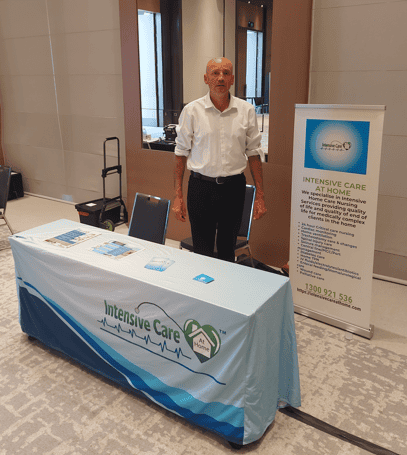
We were a sponsor of the conference, and we had a booth there, and I was also seeing a client the day before the conference in Perth. I was also interviewing staff while I was in Perth, intensive care nurses, obviously. So it’s not a matter of if, it’s a matter of when we’re opening up our first client and hiring our first staff in Perth. So, it’s really exciting.
When I was at the conference, I met many ICU doctors, ICU nurses, ICU physios, and also some community nurses, and also some community physios and clearly, there’s a need for Intensive Care at Home in WA and in Perth as well. Many bed blocks in ICU that we can help alleviate with our critical care nursing workforce in the community by taking long-term ventilated adults and children with tracheostomies home.
Also, interestingly enough, it was also clear to me that especially MND (Motor Neurone Disease) patients in Western Australia are having a high need to be looked after by a higher skill level. Many MND patients are on BIPAP (Bi-level Positive Airway Pressure), CPAP (Continuous Positive Airway Pressure), they are having nasogastric tube, and PEG (Percutaneous Endoscopic Gastrostomy) tubes. Some of them have a tracheostomy, but they haven’t got critical care nurses at home just as yet because we’re just really breaking into the Perth market.
So, a little of it sounds like it’s similar to the East Coast in Australia, whether it’s Sydney, Melbourne, Brisbane, but obviously, it’s an under-resourced market, and we’re here to help. I have more to say about our Perth expansion in the next few months. I’m positive we’ll have a business development manager over there in the next couple of months and also staff and clients. So, I have more to say about that.
So, this is really brief. I will also put a link towards underneath this video to the conference that we attended, and it was really a great conference. Thank you for the organizers, and it was really great to speak to many like-minded people at the conference.
So, another thing that came out of the conference was I was also talking to some ED/ICU consultants, and they were also saying that even EDs are overflowing because we have also provided an emergency department bypass service for the Western Sydney Local Area Health District where we have sent our critical care nurses into the home for emergency department bypass services. We were changing nasogastric tube, PEG tubes, unblocking catheters, changing catheters, whether it was SPC (suprapubic catheter) or IDC (indwelling urinary catheter), and changing tracheostomy tubes to keep patients out of ED. That’s what we do with Intensive Care at Home, and we can do the same all around the country.
So, having said all of that, with Intensive Care at Home, we are currently operating all around Australia in all major capital cities as well as in all regional and rural areas. We’re an NDIS (National Disability Insurance Scheme) approved service provider all around Australia, TAC (Transport Accident Commission) and WorkSafe in Victoria, iCare in New South Wales, NIISQ (National Injury Insurance Scheme in Queensland), as well as the Department of Veteran Affairs (DVA) all around Australia. Our clients and we, as a provider, have also received funding through public hospitals, private health funds, as well as departments of health.
That basically means we are currently sending our critical care nurses into the home, 24 hours a day. That means we are providing a genuine alternative to a long-term stay in intensive care for ventilation, tracheostomy, Home BIPAP (Bilevel Positive Airway Pressure), Home CPAP (Continuous Positive Airway Pressure), ventilation without tracheostomy, tracheostomy without ventilation, Home TPN (Total Parenteral Nutrition), home IV potassium, home IV magnesium infusions, IV fluids, and IV antibiotics. We’re also providing ventilation weaning at home. We’re also providing central line management, PICC (Peripherally Inserted Central Catheter) line management, Hickman’s line management, as well as port management at home. We’re also providing nasogastric tube and PEG tube management at home, as well as palliative care services at home.
We’re also sending our critical care nurses into the home for emergency department bypass services. Like I said, we have done so successfully as part of the Western Sydney Local Area Health District, their in-touch program, saving approximately $2,000 per patient that we keep at home, instead of them going to the emergency department.
Therefore, we’re also in a position to cut the cost of an intensive care bed by around 50%. An intensive care bed costs around $5,000 to $6,000 per bed day. Our services costs between $2,500 to $3,000 per day and we’re freeing up the most sought-after bed in the hospital, which is the ICU bed. But most importantly, we’re improving the quality of life for patients and their families which is a win-win situation for all stakeholders.
We are also the only service provider in Australia that has achieved third-party accreditation for Intensive Care at Home nursing in 2025. We have been achieving this level of accreditation since 2012. No other provider has achieved this high level of accreditation in the community and has created more intellectual property for Intensive Care at Home than we have. This puts us in a position to employ hundreds of years of critical care nursing experience combined in the community. No other service provider in 2025 employs a higher skill level in the community than we do, which enables us to look after the highest acuity adults and children in the community in Australia safely.
If you’re at home already and you’re watching this, and you realize that you don’t have the right level of support, or if you’re stuck in an ICU long-term or if your family member is stuck in an ICU long-term, I’ll give you a very tangible and real-world example today.
One of our first clients over 10 years ago, when we first got started, he was a client who was at home initially on a ventilator with a tracheostomy with a support worker model 24/7. Of course, it’s dangerous and negligent having support workers look after a client at home on a ventilator with a tracheostomy. That is like flying the airplane with the cabin crew instead of the pilot because anyone on a ventilator with a tracheostomy is at very high risk of medical emergencies 24/7 or even at risk of dying if they don’t have a team of critical care nurses looking after them 24/7. This is actually evidence-based and is documented in our Mechanical Home Ventilation Guidelines that you can find on our website at intensivecareathome.com.
Think about it, in an intensive care unit in a hospital, you wouldn’t have support workers looking after a critical care patient on a ventilator with a tracheostomy. So, why would anyone in their right mind do that in a home care environment in the community?
So eventually, this client found out about us. We were proving our concept with this client very fast. When we worked with the client, we sent him intensive care nurses, 24 hours a day. He never, ever went back into ICU ever again and we were proving our concept there very fast.
We can do the same for you if you’re not safe at home, which includes the advocacy for funding that goes along with it. We have always successfully advocated for our clients. Otherwise, we would not be in business. The same is applicable for those stuck in ICU, similar to our case here today to what you are looking for. Reach out to us, we’ll make it happen for you as well, we can take you through the right steps, including NDIS or other funding bodies’ funding.
This is also why we are providing Level 2 and Level 3 NDIS Support Coordination. We have a team of NDIS Support Coordinators, and they have a wealth of knowledge. I’ve done an interview with Amanda Riches, one of our NDIS Support Coordinators, and I’ll put a link to an interview with Amanda in the written version of this blog. We’re also providing TAC case management and WorkSafe case management in Victoria with Lucy McCotter.
If you’re an NDIS Support Coordinator or a case manager from another organization watching this, and you’re looking for nursing care for your participants, please reach out to us as well. If you’re looking for funding for nursing care for your participants, and you don’t know how to go about it and what evidence to provide, I encourage you to reach out to us as well. We will help you with the right level of funding and with the right level of advocacy. We’re also providing NDIS specialist nursing assessments done by critical care nurses with a legal nurse consulting background.
If you are a critical care nurse and you’re looking for a career change, and you want to join a very progressive, dynamic, and high-performing team of critical care nurses in the community, we are employing hundreds of years of critical care nursing experience combined. If you are looking for a career change, we’re currently hiring for jobs for critical care nurses in Melbourne, Sydney, Brisbane, in Albury, Wodonga, in Bendigo, in Geelong, and in Warragul in Victoria. If you have worked in critical care nursing for a minimum of 2 years in pediatric ICU, ED, and you have already completed a postgraduate critical care nursing qualification, we are delighted hearing from you.
I have a disclaimer though, because we are offering a tailor-made solution for our clients, which includes regular staff, our clients also do want the same staff coming over and over again because they are very vulnerable and very special, and that’s why we need regular staff. So, if you’re looking for agency work where you can come and go, this will not be the right fit for you. We are looking for consistency and our clients are looking for consistency. So, please only apply with us if you can give us regular and consistent availabilities for shifts and if you’re really keen on building relationships with us and with our clients.
If you are an intensive care specialist or an ED specialist, we also want to hear from you. We’re currently expanding our medical team as well. We can also help you eliminate your bed blocks in your ICU and ED for your long-term patients, or for your regularly readmitting patients with our critical care nursing team at home. We’re here to help you take the pressure off your ICU and ED beds. In most cases, you won’t even pay for it. Even if you do pay for it, it is much more cost-effective than what you’re paying for in ICU and ED for and you get the same level of care.
If you’re a hospital executive watching this and you have bed blocks in your ICU, ED, and respiratory wards, home TPN, of course, please reach out to us as well. We can help you eliminate your bed blocks very fast.
If you’re in the U.S. or in the U.K. and you’re watching this and you need help, we want to hear from you as well. We can help you there privately with one-on-one consulting and hiring nurses privately.
Once again, our website is intensivecareathome.com. Call us on one of the numbers on the top of our website or simply send us an email to [email protected].
If you like my videos, subscribe to my YouTube channel for regular updates for families with Intensive Care at Home and intensive care. Click the like button, click the notification bell, share the video with your friends and families, and comment below on what you want to see next, what questions and insights you have from this video.
Thank you so much for watching.
This is Patrik Hutzel from intensivecareathome.com and I will talk to you in a few days.
Take care for now.
RELATED LINKS:
 Best practice guidelines for Long-term ventilated Adults& Children with Tracheostomy at Home
Going HOME from Intensive Care after a STROKE, a REAL WORLD example!
5 CONFRONTING QUESTIONS YOU NEED TO ASK WHEN LONG-TERM VENTILATED ADULTS& CHILDREN WITH TRACHEOSTOMIES ARE IN INTENSIVE CARE!
Best practice guidelines for Long-term ventilated Adults& Children with Tracheostomy at Home
Going HOME from Intensive Care after a STROKE, a REAL WORLD example!
5 CONFRONTING QUESTIONS YOU NEED TO ASK WHEN LONG-TERM VENTILATED ADULTS& CHILDREN WITH TRACHEOSTOMIES ARE IN INTENSIVE CARE!
 Dion’s fight to overcome muscular dystrophy so he can continue helping others
 How ICU/PICU nurses in the community help the health system cutting the cost of intensive care by 50%!